

Protocols for Polishing Zirconia
Article by Ivoclar North America
Zirconia, or yttria-stabilized tetragonal zirconia polycrystal (Y-TZP), has gained immense popularity in restorative dentistry due to its high strength, durability, and esthetic qualities. However, despite its impressive mechanical properties, the surface finishing protocol significantly influences surface roughness and the material’s wear behavior [2]. In this article, we will explore the optimal protocols for polishing zirconia.
Polishing Protocols for Zirconia
To achieve a smooth, esthetic surface on zirconia restorations, various polishing methods are employed. The most common techniques include pre-sinter polishing, post-sinter polishing, and glazing. Let’s examine each approach.
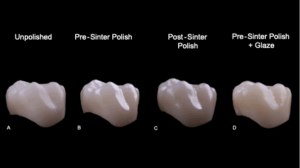
- Pre-Sinter Polishing
Pre-sinter polishing refers to polishing zirconia in its unsintered, or “green-state,” form, which is softer and allows for easier manipulation and smoothing. A series of polishers—such as the spiral-shaped OptraGloss® Extra Oral Polishers (Ivoclar)—can be used effectively during this stage. For unsintered oxide ceramics, use light pressure and maintain a speed of <5,000 RPM when pre-polishing and <10,000 RPM when high-gloss polishing.

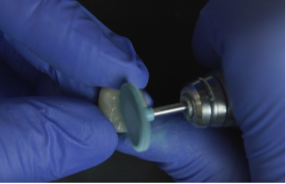
- Post-Sinter Polishing
Post-sinter polishing is performed after the zirconia has been fully sintered and is in its final, hardened form. While effective, this process is more technique-sensitive due to zirconia’s increased hardness and resistance to abrasion. As a result, achieving comparable surface smoothness may require increased polishing time relative to pre-sinter methods. For sintered oxide ceramics, complete both pre-polishing and high-gloss polishing between 10,000 rpm – 15,000 rpm.
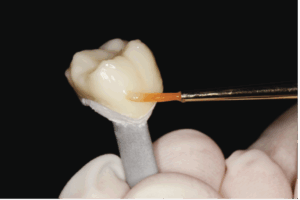
- Glazing
Glazing involves applying a glass-like coating over the sintered zirconia and firing it to produce a smooth, glossy finish. While glazing enhances esthetics, intraoral occlusal adjustments can disrupt the glaze layer, and normal functional wear may result in degradation of the glazed surface over time.

SEM images comparing pre-sinter polish (60s 2-step polish with OptraGloss®), post-sinter polish (60s 2-step polish with OptraGloss®), and glazed (IPS e.max® CAD Crystall./Glaze Paste) zirconia surfaces show that pre-sinter polishing with systems like OptraGloss for 60 seconds produces the smoothest surface finish. In contrast, both post-sinter polished and glazed zirconia exhibit greater surface roughness, particularly in the difficult-to-reach buccal groove.
Furthermore, clinical literature indicates that glazed zirconia demonstrates higher wear potential against natural enamel, which may contribute to unintended damage to the opposing dentition [1][2].
Conclusion: Optimal Polishing Protocol for Zirconia Restorations
To achieve the most efficient, esthetic, and functionally sound results, pre-sinter polishing is an effective protocol. Supported by SEM images, this approach yields a smooth zirconia surface which is friendly to the opposing dentition.
While post-sinter polishing and glazing remain clinically acceptable, they may not offer the same level of efficiency. In addition, glazed zirconia finishing protocols are shown to cause more material and antagonist wear when compared to polished zirconia [2]. When choosing a glazing protocol, consider polishing the occlusal surface prior to applying glaze to help prevent additional wear to opposing dentition as the glaze degrades.
In the end, clinicians should weigh both esthetic goals and functional demands when selecting the appropriate finishing protocol for each case.
References
- Mitov G, Heintze SD, Walz S, Woll K, Muecklich F, Pospiech P. Wear behavior of dental Y-TZP ceramic against natural enamel after different finishing procedures. Dent Mater. 2012;28(8):909–918. doi:10.1016/j.dental.2012.04.010
- Janyavula S, Lawson N, Cakir D, Beck P, Ramp LC, Burgess JO. The wear of polished and glazed zirconia against enamel. J Prosthet Dent. 2013;109(1):22–29. doi:10.1016/S0022-3913(13)60005-0


Related Course

Proactive Caries Care: Harnessing AI Diagnostics and Biomimetic Repair for Superior Patient Outcomes
DATE: January 16 2026 @ 2:00 pm - January 16 2026 @ 3:15 pmLocation: Online
CE HOURS: 1.25
Proactive Caries Care: Harnessing AI Diagnostics and Biomimetic Repair for Superior Patient Outcomes Course Description: This course explores how artificial intelligence, predictive diagnostics, and guided hydroxyapatite generation are redefining early…
Learn More>
About Author
